

Social media has taken the saying “any press is good press” to heart and run with it. Algorithms often don’t care why people engage or comment, as long as they do. As a result, some creators have learned that it’s much easier to make people hate you than to make them love you.
When I think of rage-baiting, always think of Annie Bonelli, AKA Scar Girl on TikTok. Her scar became the centre of an internet frenzy. Speculation, conspiracy videos, and accusations of attention-seeking drove massive engagement. The outrage, curiosity, and heated discussions her posts sparked perfectly illustrate how rage-bait thrives on tension and controversy, capturing attention far beyond the content itself.
The content that spreads fastest isn’t necessarily the most helpful or accurate, it’s the content that triggers strong emotion. And among all emotions, anger is one of the most powerful.
Anger pushes people to stop scrolling, comment, argue, and share. From an algorithm’s point of view, that’s a win. Comments are comments, whether they’re praise or backlash. The algorithm cannot really tell the difference.
This is why rage-bait marketing keeps showing up across TikTok, X, and Instagram. Rage-bait is content designed to provoke disagreement or moral outrage to drive engagement. It works fast, it spreads far, and it’s tempting for brands chasing a quick fix.
But attention earned through anger comes with trade-offs, and not all of them are worth the risk to your brand.
1. What Is Rage-Bait Content? (And Why It Works)
Rage-bait content is designed to provoke anger, disagreement, or outrage with one primary goal: engagement.
It’s not created to inform or persuade, it’s created to trigger a reaction, and the internet loves to be triggered. The stronger the reaction, the better the engagement, and the more eyeballs on your posts, brand, and content.
This type of content works because it taps into how the human brain and algorithms actually function.
Studies show that humans are more likely to notice, remember, and react to negative information than positive or neutral content. In fact, research from MIT found that false information spreads faster on Twitter than factual reporting, largely because of emotional reactions like anger and fear.
Then there’s the fact that rage-bait content often implies that someone is wrong, ignorant, or morally inferior, nudging audiences to defend their “side.” Once identity is involved, engagement skyrockets.
There’s also a dopamine loop at play here. Conflict creates stimulation. Arguing in comments, correcting someone publicly, or “winning” a debate provides a small dopamine hit.
Finally, there’s the algorithm. They don’t distinguish between constructive discussion and heated arguments. A post with 300 angry comments will often outperform a post with 30 thoughtful likes. Rage-bait doesn’t succeed because people agree with it. It succeeds because people can’t ignore it.
2. What Are The Most Common Rage-Bait Formats on Social Media
Rage-bait rarely looks like obvious provocation. Most of the time, it’s disguised as an opinion, a “truth bomb,” it’s “just free speech”, or a confident claim that dares you to disagree in the comments. These formats are engineered to create tension fast, especially in scroll-heavy environments.
Hot Takes Framed as “Unpopular Opinions”
This is one of the most recognisable rage-bait formats. Posts that start with “Unpopular opinion, but…” are rarely unpopular, they’re intentionally polarising.
The goal isn’t to share a new perspective. It’s to trigger defensiveness and debate. Opinion-based posts generate more comments than informational ones, because they spark debate, not just agreement.
Oversimplified or Misleading Statements
Rage-bait thrives on stripping complex topics down to a single, crazy claim. By removing context, the creator creates a vacuum, and the comments rush in to fill it. These posts position the creator as a truth-teller exposing a broken system, industry, or behaviour. They often rely on dramatics, which fuel emotional responses.
Audiences don’t just react to the claim, they react to the implication that someone is to blame.
Fake concern or performative ignorance
Another common format is pretending to be confused or concerned:
- “Genuine question: why do people still do this?”
- “I’m not judging, but can someone explain why this is acceptable?”
This approach feels passive, but it’s strategic. It invites correction, criticism, and moral positioning, all high-engagement behaviours that guarantee those comments keep flooding in.
These formats aren’t accidental. They’re optimised for platforms where engagement signals matter more than agreement.
3. How Brands & Creators Use Rage-Bait as a Marketing Strategy
Rage-bait isn’t usually the end goal, it’s the entry point.
Brands and creators use outrage strategically to break through crowded feeds, knowing that controversy creates instant visibility. When used on purpose, rage-bait grabs attention first, then your other content does the convincing.
Turning Controversy into Reach
On most platforms, a post with heavy disagreement will outperform a post with quiet approval. Comment-heavy content is pushed further, faster. This is why creators sometimes post opinions they know will be challenged, the argument itself becomes the distribution mechanism.
In practice, this looks like:
- Posting a polarising statement to spark debate.
- Letting the comments do the work.
- Following up with clarifying or educational content.
- Or it can start as rage-bait but clarify by the end.
The outrage becomes the hook. The nuance comes later.
Comments as Visibility Engines
Every reply, correction, and argument extends the life of a post. Longer comment threads signal relevance, keeping content circulating beyond its original audience.
Data from multiple platform analyses shows that posts with active comment threads can receive significantly higher reach than posts optimised only for likes or saves. Rage-bait accelerates this by encouraging back-and-forth interaction, not passive engagement.
Rage-bait as Positioning
Some brands use outrage to define what they stand against.
Instead of saying, “Here’s what we believe,” they imply they are breaking norms and thinking outside the box. One brand that has made this a core part of its identity is Liquid Death, their entire voice is provocative and confrontational, turning the blandness of typical water marketing into something bold, irreverent, and memorable.
@liquiddeath $450/can and only 10 for sale. Link in bio. #liquiddeath #ozzyosbourne #DNA #clones ♬ original sound - Liquid Death
This creates instant alignment with one group, and instant rejection from another. That polarisation isn’t accidental. It sharpens brand identity and makes the brand memorable.
When rage-bait works, it creates momentum fast. Growth spikes. Visibility increases. The brand becomes part of the conversation. But momentum built on outrage is unstable.
4. The Risks of Rage-Bait Marketing (And When It Backfires)
Rage-bait is effective, but it’s not stable. While it can generate rapid spikes in reach and engagement, it often comes with hidden costs that don’t show up in analytics dashboards right away.
Loss of Audience Trust
When audiences realise a brand is provoking outrage for attention, trust weakens. People may follow, comment, or argue, but they don’t necessarily respect the brand.
Credibility and consistency matter more for long-term loyalty than visibility. If a brand becomes known for manipulation rather than insight, engagement may remain high while conversion quietly drops.
Attracting the Wrong Audience
Rage-bait pulls in people who enjoy conflict, not necessarily people who align with your values or offerings.
This can lead to:
- High follower counts with low intent.
- Comment sections dominated by hostility.
- Communities built around disagreement rather than shared purpose.
Over time, this makes it harder to publish thoughtful or educational content without pushback.
Brand Fatigue and Outrage Burnout
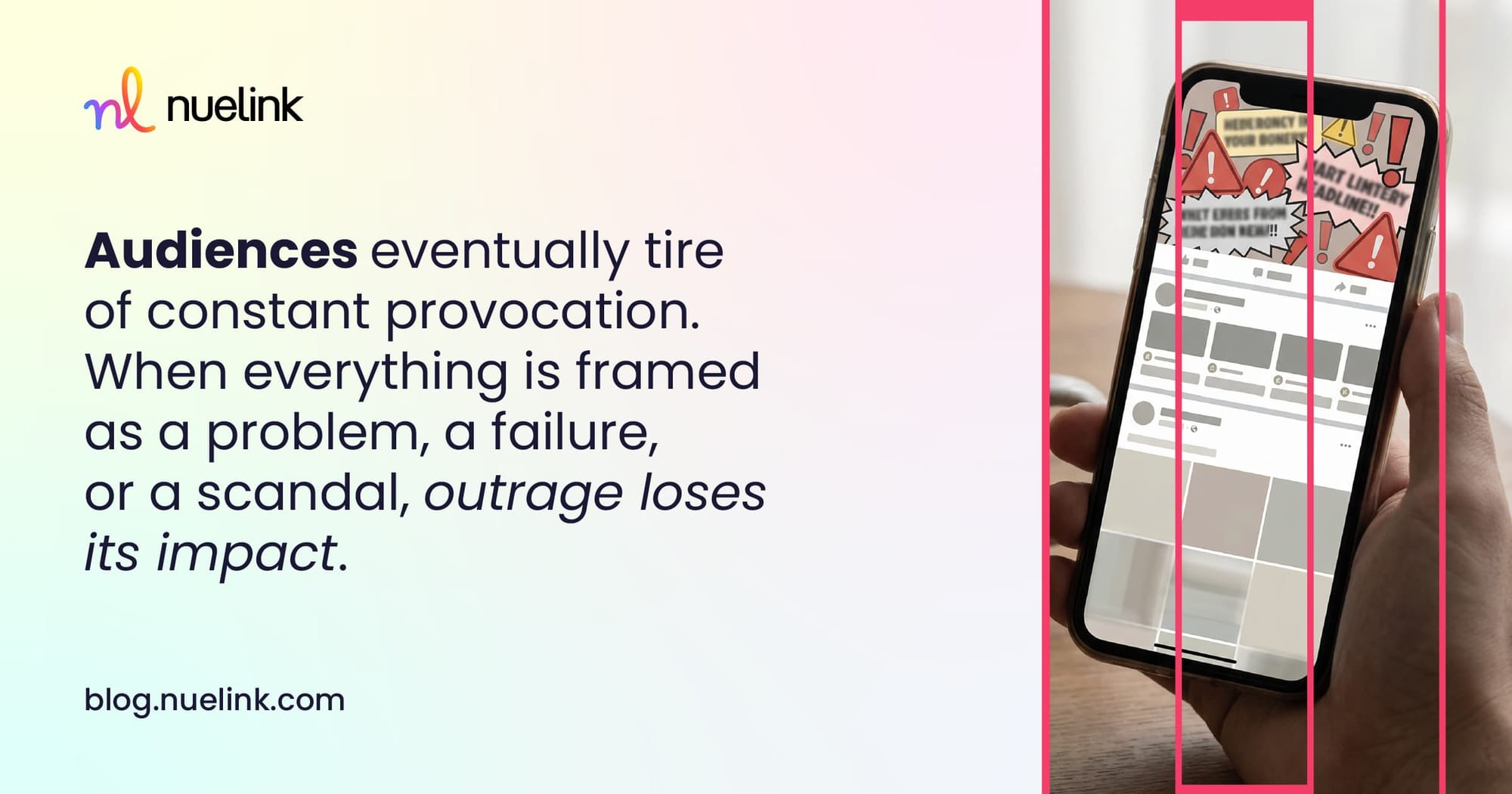
Audiences eventually tire of constant provocation. When everything is framed as a problem, a failure, or a scandal, outrage loses its impact.
Creators who rely heavily on rage-bait often find themselves needing to escalate to stronger claims, harsher language, and bigger controversy, just to maintain the same level of engagement.
That cycle is difficult to sustain and even harder to reverse.
Platform Penalties and Suppression
While platforms reward engagement, they also monitor patterns associated with misinformation, repeated policy-adjacent behaviour, or consistently hostile interactions.
The algorithm gives, but it can just as easily take away.
Short-term Reach Versus Long-term Growth
Rage-bait can inflate metrics quickly, but growth built on outrage rarely compounds. Sustainable brands grow through trust, clarity, and relevance, not constant provocation. The attention might be easy to earn. The consequences are not.
Rage-bait is powerful, but it’s not a strategy, it’s a momentum. Used intentionally, it can spark conversation, surface tension, and draw attention to important issues. Used carelessly, it erodes trust, attracts the wrong audience, and turns a brand into a perpetual outrage machine.
Tools like Nuelink can help manage this balance by automating social media posting, scheduling content strategically, and ensuring your most provocative posts align with a bigger plan.
Attention is easy to get in a loud feed. Respect is harder to earn, and easier to lose. The brands that win long-term aren’t the ones people argue with the most, they’re the ones that use tools and strategy to balance momentum with credibility.


