

If you were creating on Twitter in 2022 or early 2023, monetisation wasn’t part of the conversation. The platform was a place to connect in real-time, not a payout engine. Creators used it to drive traffic elsewhere, newsletters, courses, YouTube, brand deals. Twitter itself didn’t pay.
That changed in 2023, when Twitter launched its Ad Revenue Sharing Program, promising creators a cut of ad revenue displayed in replies. It was the first real signal that the platform wanted to compete with YouTube, TikTok, and Meta in the creator economy.
At the time, it sounded simple. Post tweets, generate impressions, and then earn ad revenue.
But simplicity didn’t last long. Following the Twitter rebrand to X, with ad revenue declining and subscription revenue becoming a core pillar. Now, it’s influenced by subscriptions, Premium engagement, and conversational activity, not raw reach.
Many creators with millions of impressions now earn little or nothing, while smaller accounts with loyal Premium audiences earn consistently.
1. The Original Twitter Ad Revenue Sharing Program
When Twitter introduced its Ad Revenue Sharing Program in 2023, it marked the platform’s first serious attempt to pay creators and give them their share of the pie. Honesty, it has been long overdue. However, unlike YouTube or TikTok, Twitter, we still had our beloved bird back then, didn’t monetise videos or feeds. Instead, it focused on conversations.
Ads were displayed inside reply threads, not in the main timeline. If a tweet generated enough discussion, ads could appear between replies, and creators would earn a share of that revenue.
At launch, eligibility was intentionally narrow. To qualify, creators needed:
- An active Twitter Blue subscription.
- At least 5 million impressions across their tweets in the past 3 months.
- A verified account in good standing
- A connected Stripe account for payouts.
On paper, this positioned Twitter monetisation as performance-based. In practice, it heavily favoured a small subset of creators.
How payouts worked in 2023
Twitter never published a clear RPM or payout formula, but early creator reports showed wide variance. Some creators shared screenshots of payouts ranging from $50 to $263K, this is how much MrBeast made at least.
Creators with large followings, highly polarising content, and constant reply activity tended to earn the most. That’s because ads only appeared when users scrolled deep into reply threads. A tweet with 1 million impressions but few replies could earn less than a tweet with 200,000 impressions and thousands of comments.
This made earnings unpredictable. Two creators with similar reach could see a 10x difference in payouts.
Why payouts felt inconsistent
The biggest issue wasn’t low earnings. It was opacity. Creators didn’t know:
- Which replies were monetised.
- How often ads appeared.
- What percentage of revenue they received.
- Or how advertiser demand affected payouts.
Since ads were limited to replies, monetisation also depended on behaviour, not reach. Educational threads, announcements, and outbound links often earned nothing, while controversial or rage-bait posts performed better. Which did not make for good content.
X shifted its business model away from ads and toward subscriptions, a reply-only ad revenue system no longer aligned with the platform’s goals. And that’s exactly where the monetisation reset began.
2. What Changed with X Monetisation
By late 2024, it became clear that the original ad-revenue-only model wasn’t sustainable for X. The rage-bait content was not sustainable for my sanity as well.
Advertiser spending on the platform had dropped since the Twitter rebrand, with multiple industry reports estimating a 60% decline in ad revenue compared to pre-acquisition levels.
At the same time, X was aggressively pushing Premium subscriptions as a core revenue stream, and even did a price hike to help “support creators”.
From ad revenue to engagement-based earnings
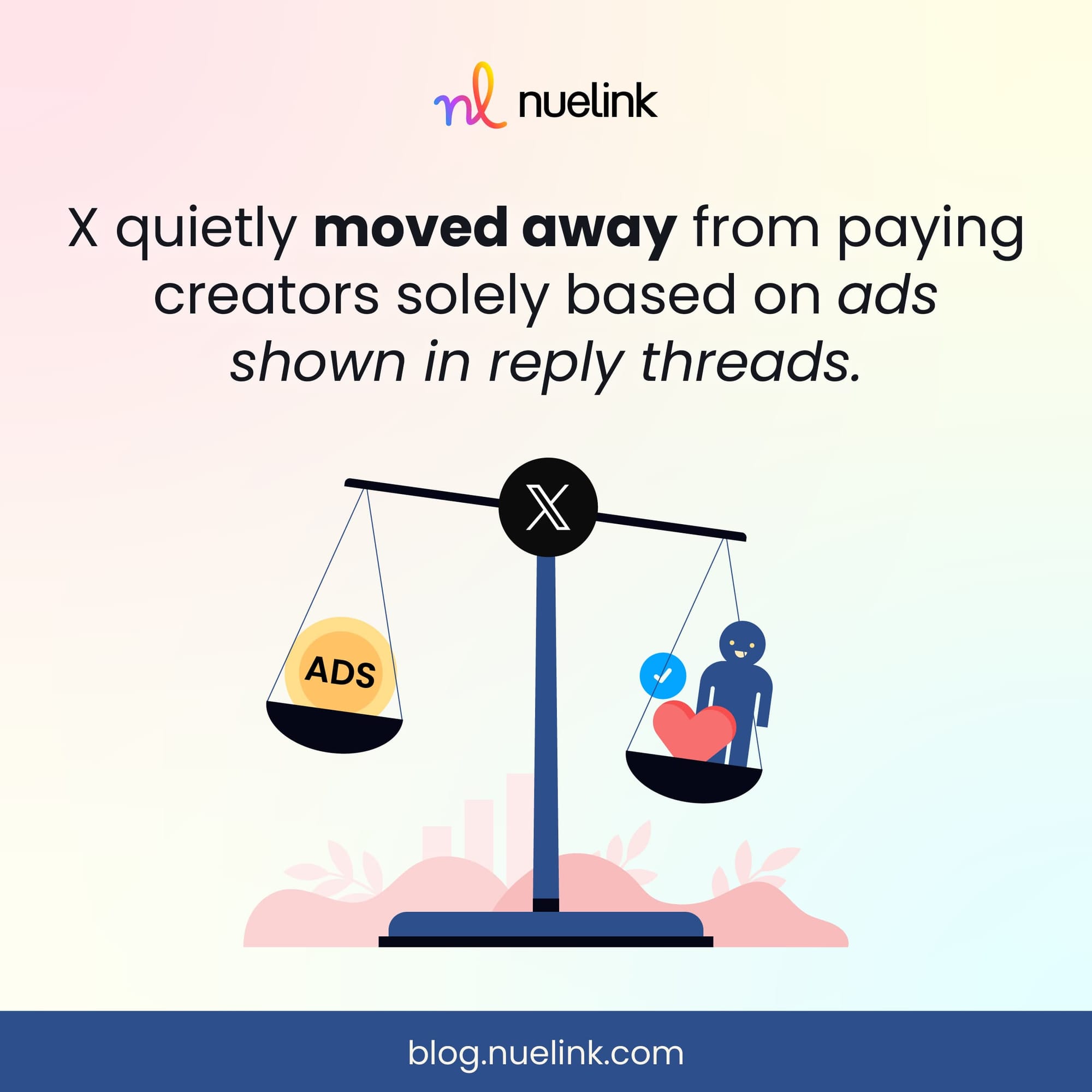
X quietly moved away from paying creators solely based on ads shown in reply threads. Instead, payouts became engagement-weighted, with a strong bias toward interactions coming from X Premium users.
Under the new system, revenue is influenced by:
- Engagement from Premium subscribers.
- Participation in paid subscription ecosystems.
- Overall contribution to on-platform conversation.
This means impressions alone no longer drive earnings. A post with 2 million views but minimal interaction from Premium users can generate little to no revenue, while a post with 100,000 views and heavy Premium engagement may pay out consistently.
Why impressions stopped mattering
In the original model, creators chased viral tweets to cross the 5M impressions in 90 days threshold. Under the new system, X prioritises who is engaging, not how many.
Premium users represent recurring revenue for the platform. Their engagement is more valuable, more measurable, and more predictable. As a result, likes, replies, bookmarks, and quotes from Premium accounts carry more weight than passive scrolling from free users.
The subscription revenue pool effect
Another major change was the introduction of a shared revenue pool tied to subscriptions, not just ads. This is why payouts fluctuate month to month, even when posting volume stays the same.
Creators aren’t just competing against their own past performance; they’re competing against the entire pool of monetised accounts. X monetisation now rewards creators who drive conversation inside Premium circles, not those who generate mass exposure.
And that shift directly affects who qualifies, who earns, and who doesn’t, which brings us to the current eligibility and payout system.
3. Current Eligibility & Payout System
X had fully restructured its creator monetisation around subscriptions, verification, and Premium engagement. While the program is technically “open,” the reality is that qualifying does not guarantee meaningful earnings.
Updated eligibility requirements
To be eligible for X monetisation today, creators must meet several baseline criteria:
- An active X Premium subscription, you've got to spend money to make money, I guess.
- A verified account in good standing.
- A minimum follower count, widely reported to be around 2,000 followers.
- Consistent, monetisable engagement from Premium users.
- A connected Stripe account for payouts
X processes creator payouts through Stripe, with minimum payout thresholds typically reported between $10 and $50, depending on region. Payouts are calculated monthly, but they are not guaranteed every month.
One of the most common frustrations among creators is qualifying for monetisation and seeing zero-dollar payouts. Monetisation on X isn’t about being visible. It’s about being valuable to the paying segment of the platform.
That’s why many creators with tens of thousands of followers earn less than smaller accounts with highly engaged, subscription-heavy communities.
Which brings us to the practical question, How do creators actually optimise for this system?
4. How Creators Can Optimise Earnings on X
Under X’s current monetisation model, optimisation is less about posting more and more about posting differently. The platform now rewards creators who spark ongoing conversations, especially among Premium users, rather than those who chase impressions.
Focus on conversation-driving content
Replies are the core monetisation signal on X. Posts that invite discussion, debate, or interpretation tend to generate longer reply chains, which increases monetisable engagement. Creators earning consistently often structure posts as:
- Strong opinions with reasoning.
- Open-ended questions backed by data.
- Unpopular opinions within a niche.
- Step-by-step breakdowns that invite responses
A single post that generates 200–500 replies can outperform multiple high-impression tweets with minimal interaction.
Why replies, bookmarks, and quotes matter more than likes
Likes are the weakest signal in the current system. They’re fast, passive, and require no effort. In contrast:
- Replies signal active participation.
- Quotes extend distribution and discussion.
- Bookmarks indicate long-term value
Creators tracking performance report that posts with high bookmark-to-like ratios often generate better payouts, even with fewer total views.
Encouraging Premium engagement
Explicitly asking Premium users to engage rarely works. What does work is creating content Premium users naturally want to interact with. Premium users usually flock to niches like:
- Tech and AI.
- Finance and investing.
- Startups and SaaS.
- Marketing and creator economy.
- Politics and policy analysis.
The goal isn’t to appeal to everyone. It’s to appeal deeply to a smaller, higher-value audience.
To put it simply, standalone viral tweets still drive reach, but they rarely drive revenue on their own.
On X, monetisation now rewards relevance, consistency, and conversational authority.
X monetisation is no longer about reach, virality, or follower count. It’s about influence within Premium circles. Creators who thrive under this system are not necessarily the loudest or the biggest.
For these creators, X payouts can range from a few hundred to several thousand dollars per month, especially in niches like tech, finance, marketing, and politics. But that level of income requires intentional content design and a loyal audience that shows up to participate, not just scroll.
For everyone else, X monetisation functions more as a bonus than a business model. If you want to explore more social media monetisation opportunities, we have them listed for you.
Relying solely on X payouts is risky. Fewer than 5% of monetised creators earn consistent, full-time income from platform revenue alone, and X is no exception. Sustainable creator businesses are built by combining platform payouts with subscriptions, products, services, and external monetisation, and tools like Nuelink make it easy to manage and grow these revenue streams.


