

How to Crosspost from Facebook to Other Platforms (Without Burning Out)
Instead of treating Facebook as the final destination for your content, it becomes the starting point. A hub. A place where ideas are created, tested, and then crossposted outward to other platforms where different audiences exist.
If you’ve spent any time around social media, you know that most content today has an extremely short lifespan. A Facebook post might get a small spike of engagement in the first few hours, maybe a day if it performs well, and then it disappears. Not because it wasn’t valuable, but because it was only given one chance to be seen.
And that’s the part most people underestimate.
Organic reach is fragmented. Audiences are scattered across platforms. Even within a single platform, only a small percentage of your followers will actually see what you publish. Which means that when you post something once, in one place, you’re leaving a lot of potential reach on the table.
And this is a distribution problem. Content can be repurposed, reposted, and most importantly, crossposted.
Instead of treating Facebook as the final destination for your content, it becomes the starting point. A hub. A place where ideas are created, tested, and then crossposted outward to other platforms where different audiences exist.
Facebook crossposting, when done intentionally, isn’t about being lazy or repetitive. It’s about making sure your content actually gets the visibility it deserves, without forcing you to constantly create something new just to stay relevant.
How Facebook Crossposting Expands Your Reach
Most people approach content with a very simple question, What do I post today?
It sounds logical. It keeps you consistent. It gives you something to focus on. But it also quietly traps you in a cycle where every day starts from zero.
New idea. New post. And over time, that’s exactly what leads to burnout. A better question, and honestly a more scalable one, is where else can this go?
Because the moment you shift from creation to distribution, everything changes. That Facebook post you just published? It’s not a one-time update. It’s a content asset.
It can live as:
- A LinkedIn post reaching a more professional audience.
- A Tweet or thread post.
- A Pinterest pin that keeps driving traffic over time.
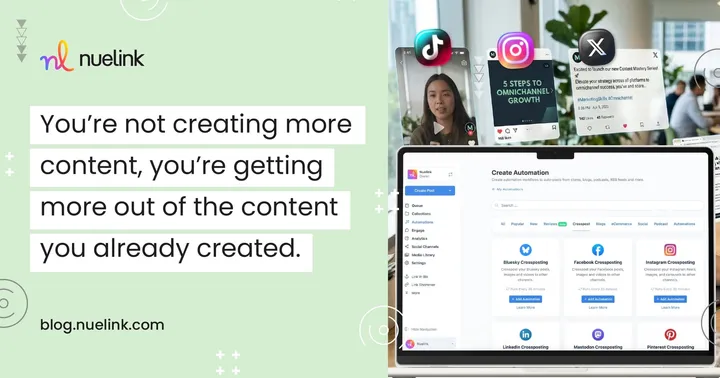
Same post. Same core message. Different platforms. And the important part here is you’re not creating more content, you’re getting more out of the content you already created.
This is how people start showing up consistently across multiple platforms without doubling (or tripling) their workload.
Because consistency isn’t really about how often you create. It’s about how well you distribute.
When you start treating every Facebook post as something that can travel, instead of something that lives and dies in one feed, you naturally increase your reach, your visibility, and the overall impact of your content.
One post can have multiple lives, across multiple platforms, reaching people who would have otherwise never seen it.
And once you start thinking this way, it becomes very hard to go back to posting in just one place.
Why Facebook Crossposting Automation Works
There’s this quiet pressure in content creation that doesn’t get talked about enough, the belief that every post needs to be new. And if it’s not new, it’s somehow less valuable.That belief is one of the fastest ways to burn out.
The reality is that most high-performing content isn’t constantly replaced, it’s reused.
According to Socialinsider, Instagram has a reach rate of 3.50% on average, while Facebook has only a 1.65% average reach rate.
That means even your best Facebook posts rarely reach everyone they could.
This isn’t copy-pasting blindly. It’s strategic, taking your top-performing Facebook posts and crossposting them to other platforms. Think about it, the post that earned your highest engagement this week? That content still has untapped potential.
On LinkedIn, posts like this often reach more new eyes than they did on Facebook because the audiences don’t fully overlap.
On Pinterest, well-designed content can continue driving traffic for months, even years. We all know the power of Pinterest as a search engine.
Instead of creating 10 separate posts every week, you can turn 1 post into 3–4 crossposting opportunities. This strategy alone can reduce creative workload by 30–50%.
When you stop thinking in terms of “new content only” and start thinking in terms of crossposting and reuse, consistency stops being exhausting. You can maintain presence across platforms without burning out.
How Facebook Crossposting Boosts Your Reach
Crossposting is often misunderstood. Many people assume it’s a lazy workaround, a way to post the same thing everywhere without thinking. In reality, done intentionally, it’s one of the most powerful growth strategies a creator or business can use.
That doesn’t mean the content performs identically on each platform, different audiences react differently, but it does mean that the same idea can reach exponentially more people when given multiple opportunities to surface.
One of the biggest advantages of crossposting is that it allows you to reach different audiences who rarely overlap. Data from Pew Research Center shows that only about 25% of adults use more than one major social platform regularly.
That means the person who sees your post on Facebook might never see it on LinkedIn or Instagram, and vice versa. By opting for Facebook crossposting, you extend your reach beyond the confines of a single network, ensuring that your message has a higher likelihood of being seen by the right people, in the right context, at the right time. It’s less about duplication and more about coverage.
Another underestimated benefit is how crossposting increases the lifespan of your content. On Facebook, posts typically get the majority of their engagement within the first 24–48 hours. After that, organic reach drops sharply. But by sharing the same content on another platform gives that post a second life, sometimes even a third.
That’s a huge return on effort, one core idea now reaches multiple audiences over multiple days, instead of vanishing after a single window.
Finally, crossposting reinforces your message and builds a sense of omnipresence, which is crucial for brand awareness. Repetition is a psychological advantage. By strategically sharing your content across multiple channels, you’re not spamming your audience; you’re giving them multiple touchpoints to absorb, remember, and act on your message.
This approach is particularly effective for product launches, promotions, educational content, and thought leadership, basically anything you want people to notice and internalize.
If you focus on creating high-quality content and then distributing it smartly across platforms, you end up with far better results than if you constantly chase the next new post for every single channel.
Streamline Your Workflow with Facebook Crossposting Automation
Crossposting is powerful, but doing it manually doesn’t scale. Copying and pasting the same Facebook post across multiple platforms quickly becomes a headache. Wrong captions, broken links, mismatched formats, errors happen.
Keep in mind that social media managers spend 6–10 hours per week just on posting and scheduling. That’s time that could be spent on strategy or engagement instead of repetitive tasks.
This is where Nuelink comes in. Their Facebook crossposting automation allows you to schedule one post and push it across multiple platforms seamlessly. You maintain consistency, save time, and reduce mistakes.
Here’s a step-by-step guide to setting it up on Nuelink, the platform we use for obvious reasons:
Step 1: Start with a Nuelink Account
First things first, get yourself set up on Nuelink. It’s quick and easy. Sign up for the free 7-day trial, and you’ll be ready to crosspost your posts.
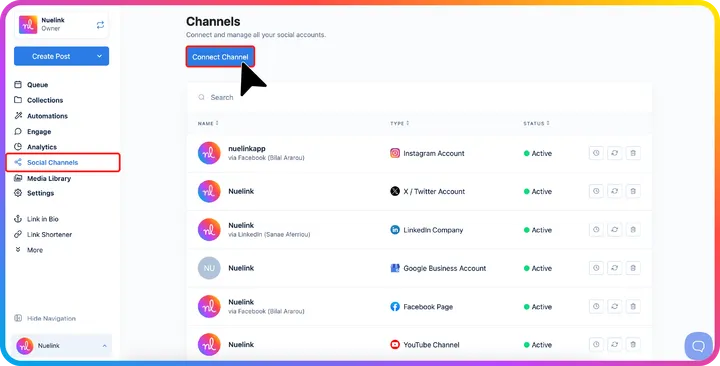
Step 2: Connect Your Accounts
Before you can start crossposting, make sure all your accounts are linked:
Facebook, Instagram, LinkedIn: Whatever platform you choose to be the source of your content, and you wish to crosspost to.
Step 3: Create a Crossposting Automation
Now that your accounts are connected, you can set up your automation:
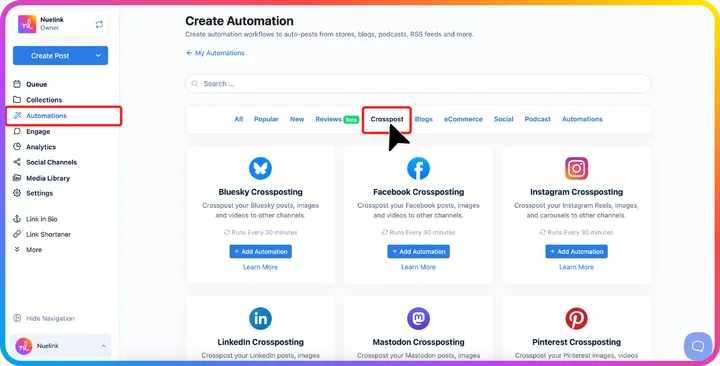
Go to Automations → Add New Automation → Crossposting.
Select Facebook Crossposting Automation.
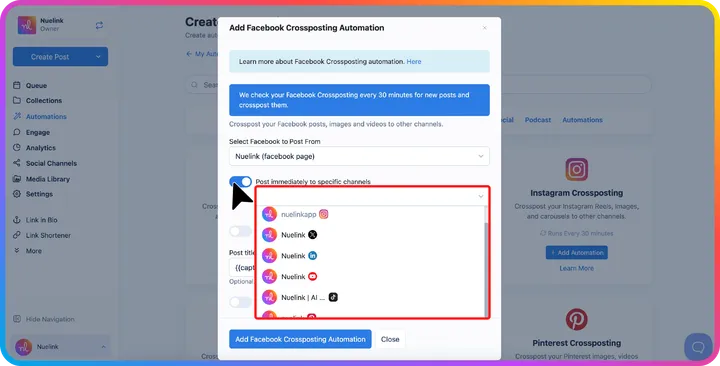
Select your Facebook account.
Choose the platforms you are posting to.
Step 4: Select Post Types
Decide what types of content you want to share, you can crosspost both image and video posts.
Step 5: Activate and Publish
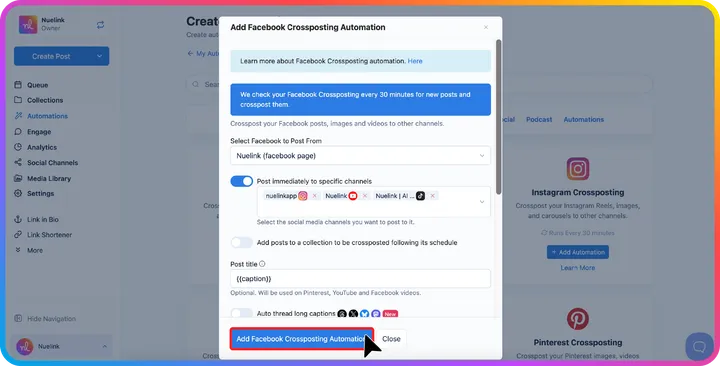
Once everything looks good, click Add Facebook Crossposting Automation.
Automation also helps with consistency and algorithm favorability. Platforms reward regular activity, and gaps in posting can hurt performance.
You don’t need more content, you need better distribution. Every Facebook post is a resource that can reach multiple platforms, audiences, and days if used strategically.
Crossposting makes one post work harder, it extends lifespan, increases visibility, and reinforces your message without burning you out.